

Thinking About Roller Blinds? Here's What to Consider Before You Decide
“I’d like roller blinds, please.” It’s one of the most common opening lines we hear at The Scottish Shutter Company. And we completely understand why. Roller blinds are everywhere. They’re in catalogues, on television, in every shop you walk past. They’ve become the default answer to the question, “What should I put at my window?”
But here’s the thing. Roller blinds aren’t always the right answer. In fact, more often than not, there’s a better option waiting in the wings. Not because roller blinds are bad. Luxaflex® offer a truly beautiful collection of roller blinds, and we’re proud to fit them. They’re frequently chosen by default rather than by design.
Before you settle on a roller blind, it’s worth pausing for a moment to ask the question we always ask our customers: what is your blind actually meant to do?
The Question We Always Ask First
At SSC, every consultation starts the same way. Before we talk fabrics, colours, or budgets, we want to understand what you’re trying to achieve. Is it warmth in winter? Cooler rooms in summer? Protection from UV damage? Better acoustics in a hard-floored room? A blackout for a child’s bedroom? Privacy without losing daylight?
The answer dictates the product, not the other way round. And the truth is, when you think about a blind in terms of performance, roller blinds rarely come out on top.
Where Roller Blinds Genuinely Shine
Let’s be fair. Roller blinds have their place. They are, above all else, an aesthetic choice. If you’ve fallen in love with a particular fabric, a striking colour, or a pattern that ties a room together, a roller blind is often the cleanest way to showcase it. The fabric is the hero, and the mechanism quietly disappears.
They’re also wonderfully simple in their lines: a flat panel of fabric, a slim cassette at the top, no slats, no folds, no fuss. For a modern, minimalist interior, that simplicity is exactly the point.
So if your priority is how the blind looks, a roller blind can be a beautiful choice.
Where Roller Blinds Sit on the Problem-Solving List
The trouble is that most people aren’t choosing a blind purely for its appearance. They want it to do something. And our job, as shading consultants, is to solve problems: warmth, glare, privacy, room darkening, acoustics, UV protection. When you line all the blind types up against that list of jobs, roller blinds (and, frankly, vertical blinds) sit quite a long way down it. There are simply better tools for most of those jobs.
- Insulation. A single layer of flat fabric does very little to slow heat moving through a window. Cellular blinds (Duette®), with their honeycomb pockets of trapped air, dramatically outperform rollers on heat retention in winter and heat rejection in summer.
- Room darkening. This is the one customers misunderstand most often. When a roller blind is sold as ‘blackout’, that word usually refers to the fabric, not the complete blind system. A blackout fabric blocks light through the cloth itself, but light still passes around the blind: down each side, over the top of the tube, under the bottom rail, and through the centre gap when two blinds are fitted side by side. So ‘blackout’ on a roller blind almost always means strong room darkening rather than true darkness. Shutters and properly fitted Duette® systems do a far better job of the latter.
- UV control. Roller blinds either block the view or let it through, with not much middle ground. Shutters and Venetians let you angle the light away from your sofa or artwork while keeping the view.
- Acoustic softening. Hard-floored rooms with large glass areas can sound quite echoey. A roller blind adds very little fabric to absorb sound. Duette® blinds add more acoustic softening.
This isn’t a criticism of roller blinds. It’s just physics. A flat single layer of fabric simply can’t compete with a folded, layered, or louvred system. So if your priority is solving a problem, we’ll usually be steering the conversation elsewhere. If your priority is the look of the fabric, that’s a different conversation, and a roller blind may well be the answer.
A Couple of Things Worth Knowing About How Roller Blinds Look
If you’ve decided a roller blind is the right answer for the room, there are two practical details worth thinking through at the design stage, because they shape the finished look more than people expect.
The tube is visible. A standard roller blind has its tube on display at the top of the window. There’s no hiding it. It’s part of the look. If you’d rather not see it, you’ll want a cassette version, which wraps the tube in a neat housing. The cassette tidies up the top, and as a happy side-effect it closes the gap between the fabric and the wall, which helps with both light leakage and a little insulation. The trade-off is that the cassette does make the blind look slightly bulkier at the top. It’s a different aesthetic, not necessarily a worse one. Just a choice to make consciously.
Roller blinds in corners and bays. Roller blinds are flat panels with clearance gaps on either side, so as soon as you put them into a right-angle corner, a square bay, or an angled bay, the gaps between adjacent blinds become much larger and much more noticeable than on a single window. You end up with visible vertical strips of glass at every internal corner, and depending on the angle, you can sometimes see straight through from one window to the next. For corner and bay situations, a roller blind may not give you the privacy or the clean finish you’re after, and a shutter or a Duette® on a continuous headrail will usually be a better answer.
Patterned fabrics and ‘bleed-through’. This catches a lot of people out. On a roller blind, the pattern is printed on the room side of the fabric, the side facing into your house. When the blind is conventionally rolled, the fabric goes over the back of the tube, which means when you raise the blind you’re looking at the reverse of the printed fabric wrapped around the tube. With a busy pattern, you can see the design ghosting through. The colours look muddier, and it can look slightly odd against the crisp pattern of the part of the blind that’s still down. There are two clean solutions:
- Reverse roll the fabric so it goes over the front of the tube. The pattern then faces you on the rolled-up portion as well, and everything looks consistent. This is the simplest fix.
- Use a cassette, which hides the rolled-up portion of the fabric entirely. Pattern bleed-through becomes irrelevant because you can’t see the tube at all.
Neither solution costs the earth, but they do need to be specified at the order stage, not retrofitted later. This is exactly the sort of thing a good consultation gets right at the planning stage, and exactly the sort of thing that goes wrong when a blind is bought blind, so to speak, online.
Three Realities Worth Knowing About Roller Blinds
There are three more practical realities of roller blinds that are easy to miss when you’re choosing a fabric in a showroom but obvious once the blinds are up.
Edge curl. Roller blind fabric is finished with a hot knife or ultrasonic cut along each long edge, which seals the weave but also creates a slightly stiffened band of material running top to bottom. Over time, particularly with PVC-coated, blackout-backed, or heavier patterned fabrics, that edge can start to curl inward toward the room. Heat accelerates it: a south-facing window, a radiator under the sill, or a sunny conservatory will all encourage it. The curl is rarely dramatic, but it does become visible as a soft wave running down each side of the blind, and it tends to slowly worsen rather than settle. Lighter, plain-weave fabrics curl less. Cassette and side-channel options can mask it. But there is no roller blind fabric that is fully immune.
The gap between adjacent blinds. This is the one that catches people out most often, and it is unavoidable as a matter of geometry. A roller blind is narrower than its brackets. The fabric needs clearance to roll up cleanly without scuffing, so each blind sits a few centimetres inside its housing on either side. Put two roller blinds side by side, on a pair of bay windows, French doors, or a wide window split by a mullion, and you get a visible vertical strip down the middle where you can see straight through to the glass. Three blinds, two strips. A wide bay with five blinds will have four. Light leaks through the gaps in the morning, headlights pass through them at night, and the eye is drawn to them whether the blinds are up or down.
This is not a manufacturing fault. It is how roller blinds work. Shutters hide it inside the frame and louvre overlap. Duette® can be ordered on a single common headrail with the cells abutting almost seamlessly. Curtains drape over the joins. A roller blind can’t disguise it.
If you have a window that needs to be split into multiple blinds, particularly a bay or a wide run of glass, this is the single biggest reason we usually steer the conversation away from rollers and toward something with continuous fabric or interlocking louvres.
Fabric smiles on wider blinds. As a roller blind gets wider, the tube has to span a longer unsupported distance, and every tube flexes slightly under the weight of the fabric it carries. The wider the span, the more flex you get. The lowered fabric then takes on a soft horizontal curve, lower in the middle than at the brackets. The industry calls this a fabric smile.
A larger-diameter tube reduces the deflection but does not eliminate it. Even on the heaviest tubes specified for the widest blinds, a faint smile is normal. Two things make it more visible. The first is the fabric: pale plain weaves and blackout-backed fabrics show ripples more readily than busy patterns. The second is lighting. Downlights or wall lights mounted directly above the blind, and close to the fabric, rake light along the surface and pick out every horizontal undulation. A wide patio-door blind with a row of LEDs in the soffit immediately above is the combination most likely to produce a smile you can see from across the room.
A fabric smile is not usually a fault with the blind. It is often a natural limitation of asking a long horizontal tube to support a large piece of fabric, then lighting that fabric from above. The plain answers for a very wide window are to specify a heavier tube, choose a fabric that hides ripple better, split the run into two narrower blinds (and accept the centre gap discussed above), or choose a different shading system altogether for that particular window.
Two Roller Blinds You May Not Have Heard Of
Before we leave the topic, it’s worth mentioning two products in the Luxaflex® range that are technically roller blinds (the fabric is wrapped around a tube and unrolls down the window) but which behave quite differently from a conventional roller. They sit in their own category, and they answer many of the performance questions a standard roller blind cannot.
Luxaflex Silhouette®

Silhouette® shades have soft, S-shaped fabric vanes suspended between two layers of sheer fabric, all wrapped onto a tube at the top. When the blind is fully lowered, you can tilt the vanes, rather like a Venetian, but in fabric. Open them, and gossamer-light sheers let you see out while the special white backing obscures the view in. Close them, and the vanes overlap to form a continuous fabric surface for full privacy. Raise the whole blind into its cassette, and the window is clear.
What this gives you that a standard roller can’t is a daytime view with privacy, something a conventional roller has to choose between. It also gives you proper UV protection (up to 88% with the vanes open, up to 99% closed) and softly diffused daylight rather than the harder light-or-no-light choice of a standard roller. The ClearView fabric option goes further still, offering a clear, sharp view to the outside even with the vanes engaged.
Luxaflex Pirouette®

Pirouette® takes a slightly different approach. Soft, horizontal fabric vanes are attached to a single sheer backing, not floating between two sheers, and the whole assembly rolls onto a tube at the top. Tilt the vanes open and you look straight through the sheer to the outside. Close them and they overlap into a continuous, beautifully textured fabric surface. The patented Invisi-Lift system means the vanes appear to float without visible cords.
Pirouette® is often chosen where the fabric itself is part of the interior design (silks, linens, satins) and where the homeowner wants the option of a clear view as well as full privacy. As with Silhouette®, UV protection is excellent (up to 81% with vanes open, up to 99% closed with ClearView fabric).
Where They Sit in the Conversation
Both Silhouette® and Pirouette® are, in our view, capable of doing rather more than a conventional roller blind. They offer view-through, daytime privacy, real UV control and softly diffused light all in one product. They sit at a higher price point than a standard roller, and they’re a different aesthetic, more of an interior-design statement than a quiet background blind. Whether they’re the right answer depends, as ever, on what the room needs the blind to do.
We mention them here because customers who ask for ‘a roller blind’ often haven’t seen these two in action, and once they have, the conversation tends to change quite naturally.
The Three-to-One Rule
There’s another technical limit worth knowing about. A roller blind shouldn’t have a drop more than roughly three times its width. It’s what we call the three-to-one rule.
Why? Because as a roller blind unrolls, the fabric tracks slightly to one side or the other depending on how the fabric was woven and tensioned. We call this runoff. On a short, wide blind, runoff is barely noticeable. But on a tall, narrow blind, that small drift compounds with every turn of the tube, and you end up with fabric rubbing against one side of the bracket and a visible gap appearing on the other.
So if you have a tall, narrow window (the kind you often find flanking a front door or in a Georgian townhouse) a roller blind is probably the wrong product. A shutter or a Duette® will give you a far better result.
Roller Blinds Are Rectangular Products
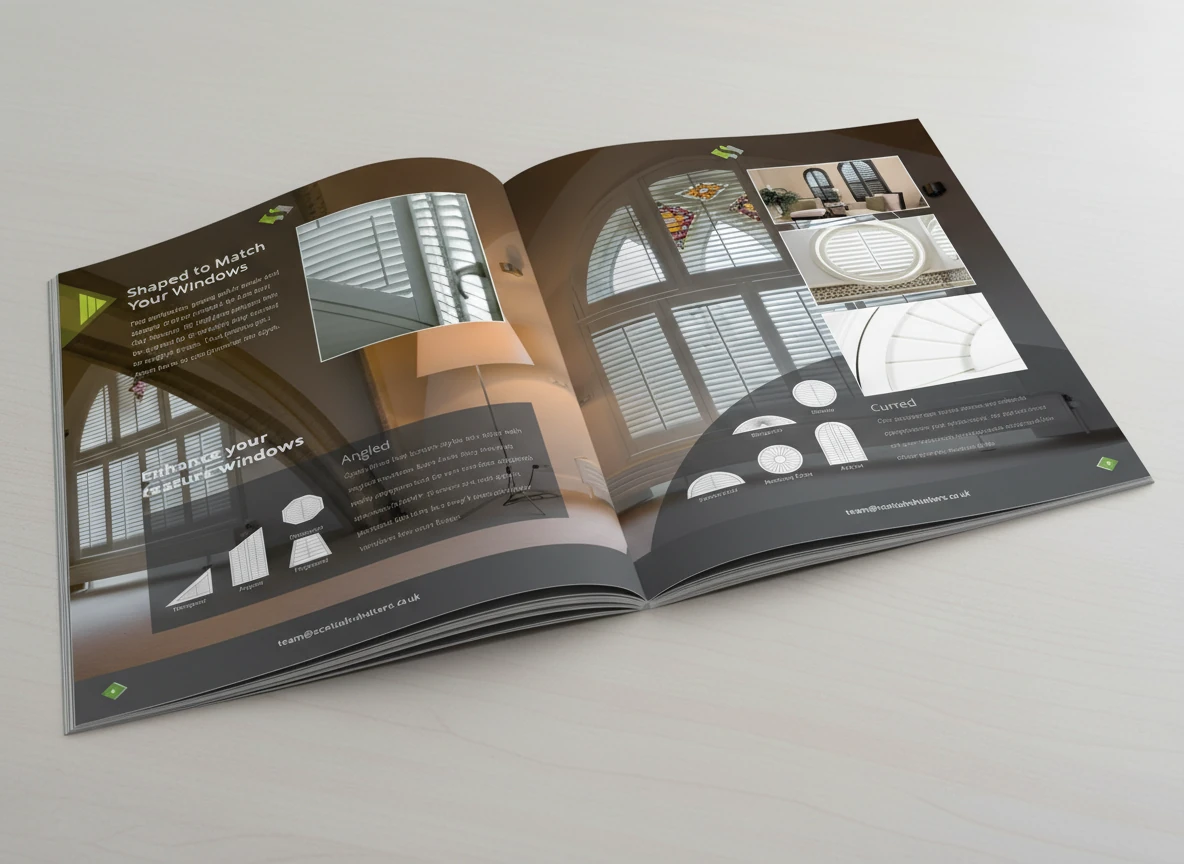
A roller blind is, mechanically, a rectangle of fabric on a horizontal tube. It works at its best on square or rectangular windows that are roughly the same shape. Triangular, gable, arched, and sloping windows do not suit a roller. The fabric cannot follow the line of an angled top, and the tube cannot run on a slope without compromise. For those windows, a shaped shutter, a shaped Duette®, or a dedicated gable system will give you a far better result. We are happy to walk you through which system suits which shape on a home survey.
Child Safety Changes the Conversation
This is the point at which we usually start steering customers towards motorisation, and there’s a very good reason for it.
Manually operated roller blinds use a chain. Under current child safety regulations, that chain has to be secured to the wall with a tensioning device, 1,500mm above the floor. That’s chest-height for most adults, and well above where a child could reach it.
This is absolutely the right rule. Chains have caused tragedies, and the regulation exists for good reason. But it does make manual roller blinds genuinely awkward to operate. You’re reaching up and across to a fixed chain rather than simply pulling something to hand.
For that reason, we almost always recommend motorising a roller blind. It removes the chain entirely, it removes the safety risk entirely, and it transforms the user experience. A discreet remote, a wall switch, or your phone. Done.
If motorisation isn’t in the budget, that’s another reason to look hard at whether a roller blind is genuinely the right product for the room.
”Aren’t Roller Blinds the Cheap Option?”
This is probably the biggest misconception we deal with. People often arrive thinking, roller blinds are the budget choice. I’ll get those instead of shutters or Duette®.
In reality, roller blinds have one of the widest price ranges of any window covering. Once you factor in motorisation, premium fabric, side channels, cassettes, and bottom-bar finishes, a quality roller blind can cost more than a Duette®, about the same, or sometimes a little less. It is genuinely not a reliable way of saving money, and if your budget is the deciding factor, we should be having a quite different conversation about what’s right for your home.
So When Should You Choose a Roller Blind?
To bring all this together, a roller blind is genuinely the right answer when:
- The fabric itself is the design statement: a particular colour, pattern, or texture you’ve fallen for.
- The window is a sensible shape: wider than it is tall, or at least within the three-to-one ratio.
- You’re happy to motorise, or the window is somewhere a chain at 1,500mm isn’t a problem.
- Performance is a secondary concern: the room doesn’t have demanding insulation, room-darkening, or acoustic needs.
When all those things line up, a roller blind can be a beautiful and well-judged choice. And when they don’t, we’ll happily talk you through the alternatives.
Why Choose The Scottish Shutter Company
We’ve been advising Scottish homeowners on shading for many years now, and the one thing we’ve learned is that the best result almost never comes from the customer arriving with a fixed product in mind. It comes from a proper conversation about how the room is used, how the light behaves, and what you want the space to feel like.
We don’t have salespeople. We have advisors: experienced specialists whose job is to recommend the right product for the room, not the most expensive one. Sometimes that’s shutters. Sometimes it’s Duette®. Sometimes it’s a Luxaflex® Venetian. And yes, sometimes it’s a roller blind, and we’ll happily fit you a beautiful one.
What it isn’t, is whichever product the customer mentioned first.
Let’s Have the Right Conversation
If you’ve found yourself thinking ‘I’d like roller blinds, please’, we’d love to talk to you. Not to talk you out of them, but to make sure they’re genuinely the right answer for your home.
Our Dundee and Edinburgh showrooms are open by appointment only, so you get the complete and undivided attention of one of our specialists for the full length of your visit. We also run home surveys across Scotland and offer virtual consultations if that is easier. To arrange an appointment, call 0800 086 2989 or request a home survey. You can also download our brochure to explore the full range of shading systems we offer.
Frequently Asked Questions
Do blackout roller blinds make a room completely dark?
Not quite. The word ‘blackout’ on a roller blind almost always refers to the fabric, which is designed to block light passing through the cloth itself. Light still passes around the blind: down each side, over the top of the cassette, under the bottom rail, and through the centre gap if you have two blinds side by side. So a blackout-fabric roller blind gives you strong room darkening rather than true darkness. If true darkness is the requirement (a baby’s bedroom, a shift worker, a home cinema), shutters or a Duette® on a single common headrail will do the job better.
Why is there a gap at the side of my roller blind?
It is part of how the blind is designed, not a measuring or fitting error. The fabric on a roller blind has to be narrower than the brackets on each side so it can roll up cleanly without scuffing the housing. The clearance is small, typically 15 to 25mm per side depending on the system, but it is always there.
Why is there a gap between two roller blinds?
Each blind has its own brackets and its own clearance, so when two are fitted side by side the gaps add together. Two blinds with around 20mm of clearance on the inner edge of each will leave a centre strip of around 40mm where you can see straight through to the glass. On a busy patterned light-filtering fabric you might not notice it. On a plain blackout-backed fabric, the contrast turns it into a bright vertical strip every time the blinds are down.
What is edge curl on a roller blind?
The two long edges of a roller blind fabric are sealed by a hot knife or ultrasonic cutter, which creates a slightly stiffened band running top to bottom. Over time, on heavier or coated fabrics and especially in warm or south-facing rooms, that edge can curl slightly inward toward the room. It rarely becomes dramatic, but it does become visible, and on side-by-side blinds it makes the centre gap look slightly wider than it actually is.
What is a fabric smile on a roller blind?
On a wider blind, the tube has to span a longer unsupported distance and flexes a little under the weight of the fabric. The lowered fabric then takes on a soft horizontal curve, lower in the middle than at the brackets, and the industry calls it a fabric smile. A larger-diameter tube reduces the deflection but cannot fully eliminate it. Bright lighting directly above the blind, particularly downlights in a soffit, will pick out any ripple and make the smile more obvious.
Are roller blinds suitable for very wide windows?
They can be, but they need careful specification. A wider blind needs a heavier tube to control deflection, a fabric chosen to hide ripple rather than emphasise it, and lighting that does not rake across the blind from immediately above. Sometimes the right answer is to split a very wide window into two narrower blinds and accept the centre gap. Sometimes a different shading system is the better answer for that particular window.
When should I consider a different type of blind?
If you want true darkness, minimum side gaps, a perfectly flat appearance on a large blind, a blind for a triangular, arched, or sloping window, or strong insulation on a draughty period window, a roller blind is rarely the best tool. A free home survey is the quickest way to work out whether your situation is one a roller blind handles well, or one where another system will give you a noticeably better result.
Inspired by what you've read?
Request a brochure or arrange a no obligation consultation.